Procurement Intake. Standardised. Controlled. Compliant.

Torus CCM standardises purchase requisition intake — by whoever, wherever — closing the gaps that create miscoded GL accounts, missing SSJ and IR35 evidence, incomplete scopes, and unapproved vendors.

Every request leaves the system as a Certificate of Compliance — the full data snapshot, the evidence, the activity timeline, the rules it was judged under, and a verification code anyone can check. Ready to key into your ERP with nothing left to correct downstream.

Certificate of Compliance 82B8-F66D-6597-9E23-30CE Verified
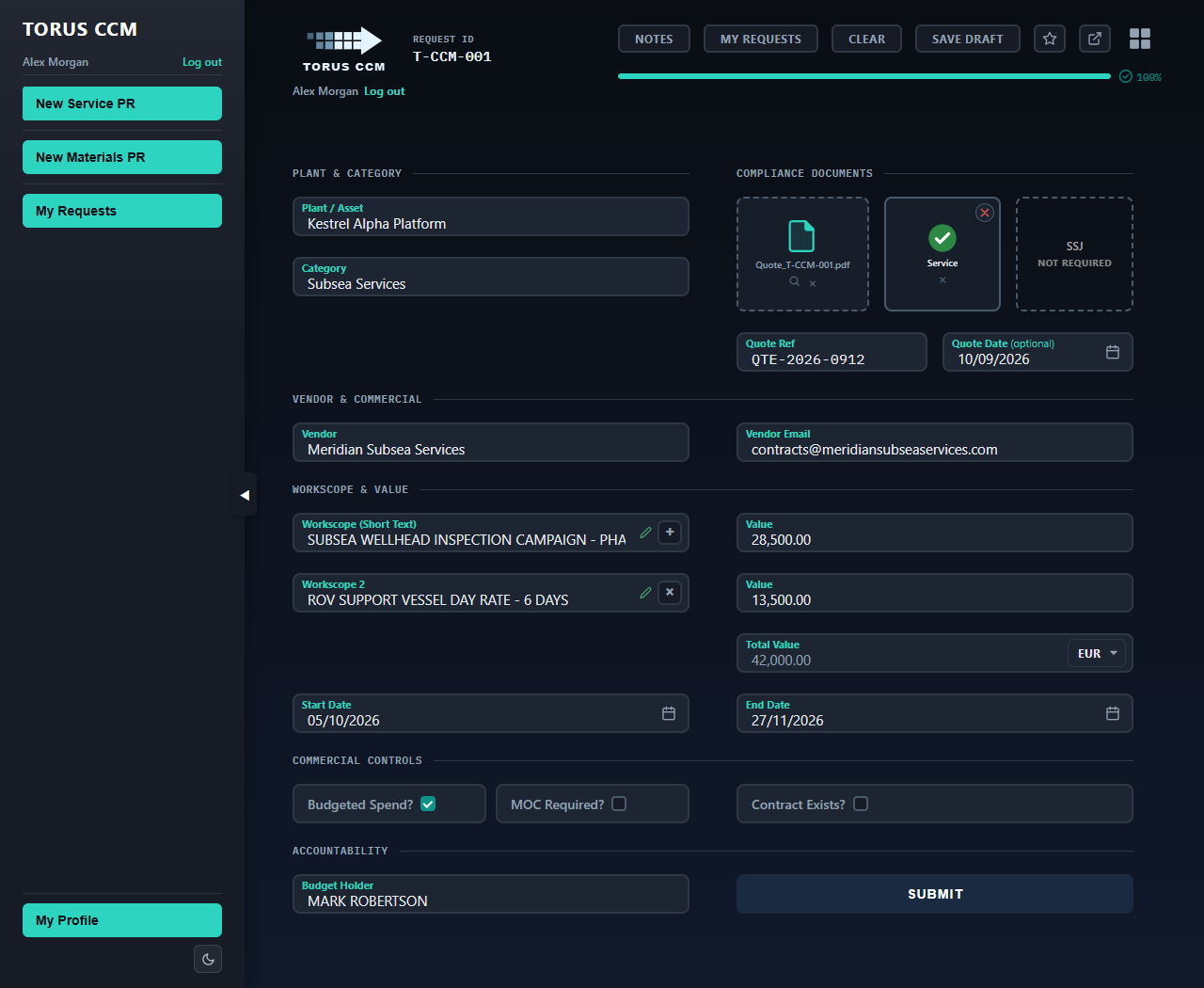
Torus CCM Service PR intake form, dark mode
Built for teams working across
Operators EPC & Service Companies Renewables Developers Supply Chain & Compliance
THE PROBLEM

Inconsistent Intake Formats Create Rework, Delay, and HMRC Exposure

Email and spreadsheet based requests leave too much room for error: incomplete information, wrong coding, missing attachments, and no consistent compliance checks.

These issues don't appear as costs at intake. They appear later — in Finance, in Compliance, during audits — as rework nobody budgeted for.

And without IR35 validation built into the workflow, every service request risks HMRC non-compliance.

Cost: Inconsistent Intake

Formats Vary. Accuracy Varies. The Workload Doesn't.

Requests arrive through email, spreadsheets, and ad-hoc templates — each with different structures, missing fields, and incomplete documentation. Whoever, wherever, ends up sending something different.

Torus CCM standardises all intake into one clean, compliant workflow, eliminating the variability that creates downstream rework.

Cost: Incorrect Coding

Requesters Guess. Finance Corrects.

Most requestors aren't financial coders — but they're often forced to guess GL accounts, cost centres, or tax treatment just to get a request moving.

Torus CCM removes that risk entirely: requestors enter operational detail, and Finance assigns the correct coding through controlled workflows.

No more miscoded requisitions. No more corrections after the fact.

Cost: Manual Reconstruction

A Final Human Gate Prevents ERP-Level Problems.

Before anything reaches the ERP, Torus CCM enforces a final compliance check — ensuring all data, documents, approvals, and IR35 evidence are complete and correct.

This prevents the painful scenario operators know too well: rebuilding a requisition's history from scattered inboxes and spreadsheets when Finance or Compliance needs proof under deadline.

Cost: Placeholder Data

"N/A". "TBC". A Row of Zeros.

Open any real requisition table and the mandatory coding fields are full of placeholders — not because anyone was careless, but because the form demanded a value the request didn't have.

Torus CCM asks only for the fields the chosen account assignment actually uses, and rejects placeholder text in the ones it does ask for.

THE SOLUTION

One workflow, five guarantees

Every guarantee below exists to stop a specific kind of rework — not to add process for its own sake.

One way to raise a request

Email chains, spreadsheets, and inconsistent templates disappear.

Torus CCM gives every requester — whoever, wherever — the same structured workflow.

Clean, complete intake becomes the default, not a best-effort.

Built-in compliance from the first click

Every request is validated against your rules before it reaches Procurement or Finance.

Categories, AVL alignment, thresholds, documentation requirements, and IR35 justification are enforced automatically.

Compliance isn't something you check later — it's embedded at intake.

Audit-ready by design

Every action, change, approval, and document is captured automatically.

No inbox-digging. No reconstruction. No surprises during audits or investigations.

Torus CCM produces a complete, chronological record that stands up to scrutiny.

Configurable strictness

Operators differ in risk appetite — Torus CCM adapts.

Whether you need light-touch guidance or locked-down governance, workflows remain compliant either way.

You choose the level of control; Torus enforces it.

Guided, not dumbed down

Audit-ready capture needs a lot on screen at once — closer to a cockpit than a consumer form, and built that way on purpose.

Requestors enter what they know; the system asks for the rest, in order, and won't let a request move until it has it.

Correct requisitions first time — whoever, wherever.

HOW IT WORKS

A governance engine, not another form

Torus CCM keeps a human in the loop at every stage — it certifies the data, it doesn't replace the people who own the decision. Five gates, five real screens.

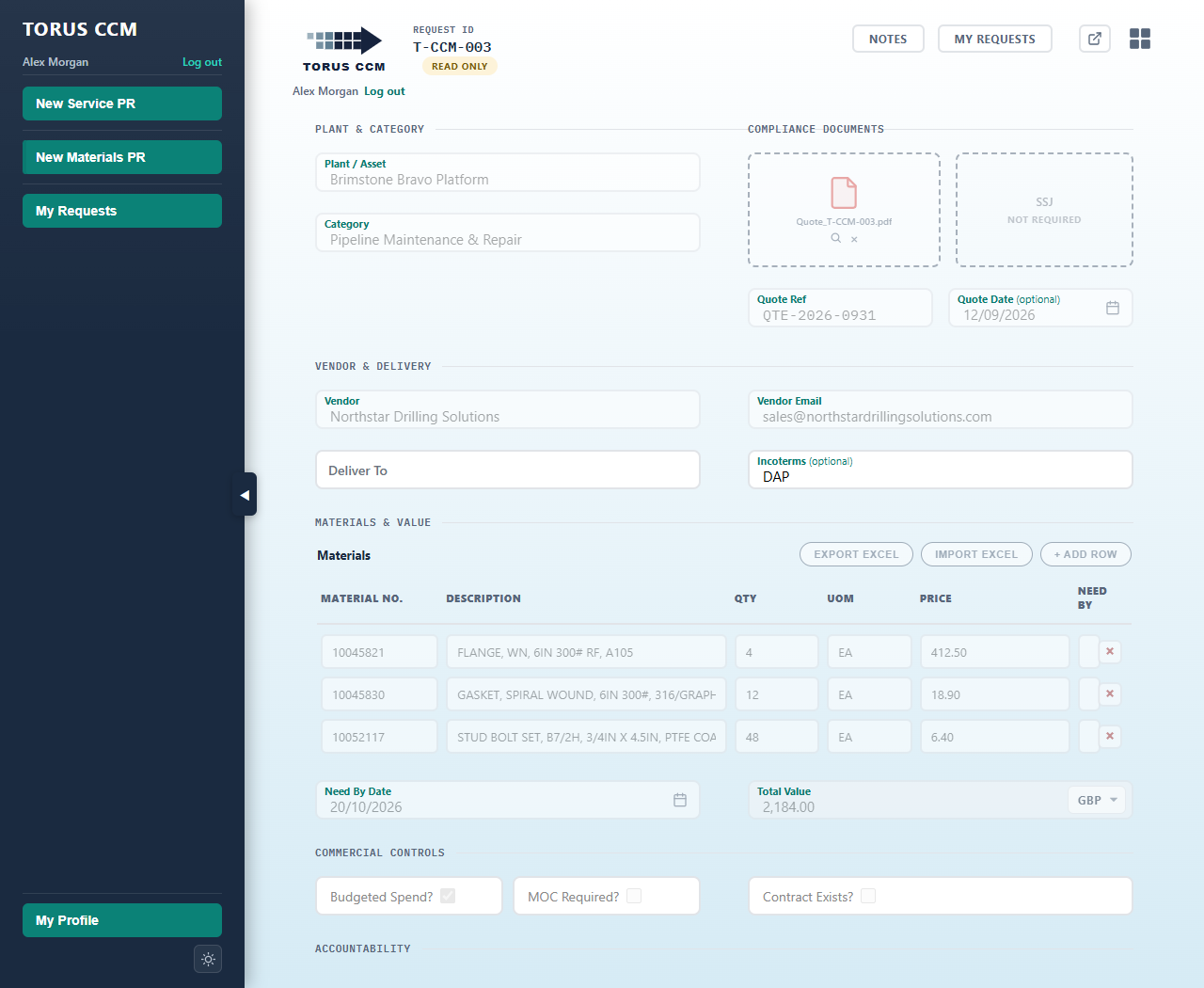
Service PR submission form
1

Input

Requestors raise a Service or Materials request using one standard workflow — no emails, no spreadsheets, no inconsistent templates.

They select the approved vendor, asset, and category from locked, admin-managed lists — no free-text supplier names to reconcile later. Multi-line workscopes and itemised material tables are supported, with the total value computed rather than typed.

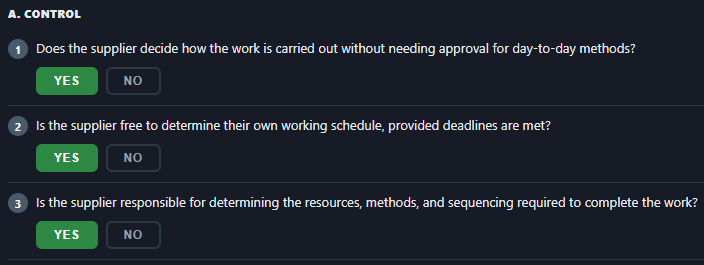
IR35 compliance checklist with a Service result
2

Certify

An 11-question weighted IR35 assessment. An SSJ requirement that converts live against your own FX rates, so a threshold means the same thing in any currency. Minimum-length justifications, and the required documents attached.

A contract on file removes the SSJ requirement; an exemption needs a written reason. Nothing moves until this is complete.

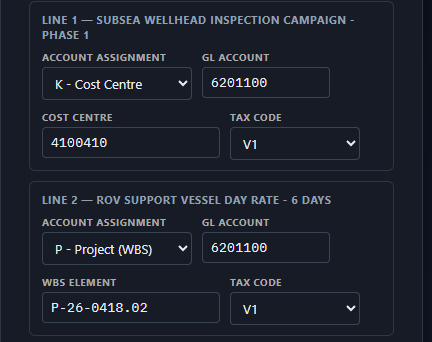
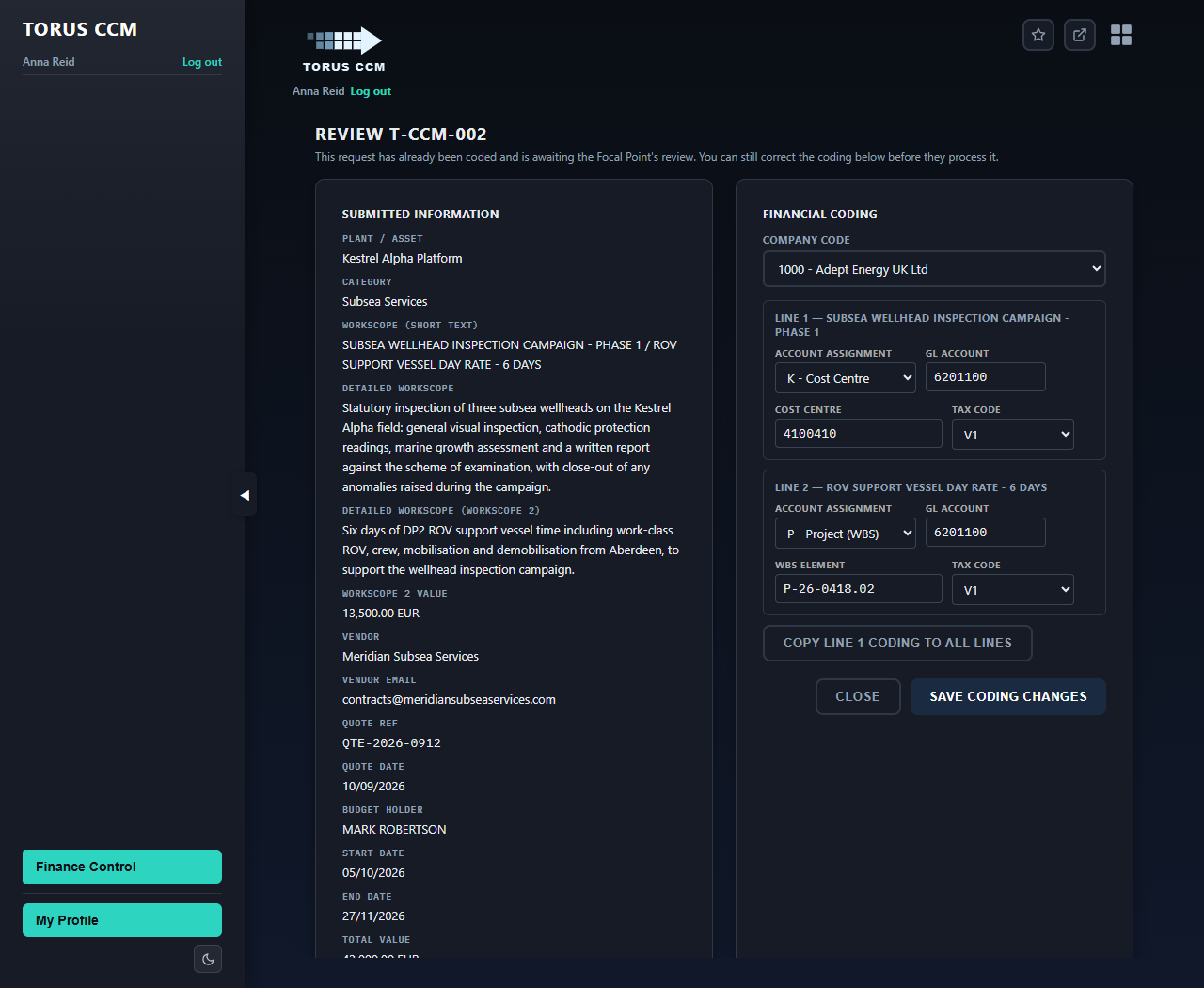
Finance Control financial coding review screen
3

Code

Per line, not per requisition. Finance picks the SAP account assignment category for each line — K, P, F or A — and the system asks for the one cost object that category uses and rules out the others.

A company code scopes the whole requisition to one legal entity, and that entity's own format rules and tax codes apply. Joint venture billing is captured as venture, equity group and recovery indicator — never a single code.

Requestors provide operational detail; Finance provides financial accuracy. No guessing, no corrections after the fact.

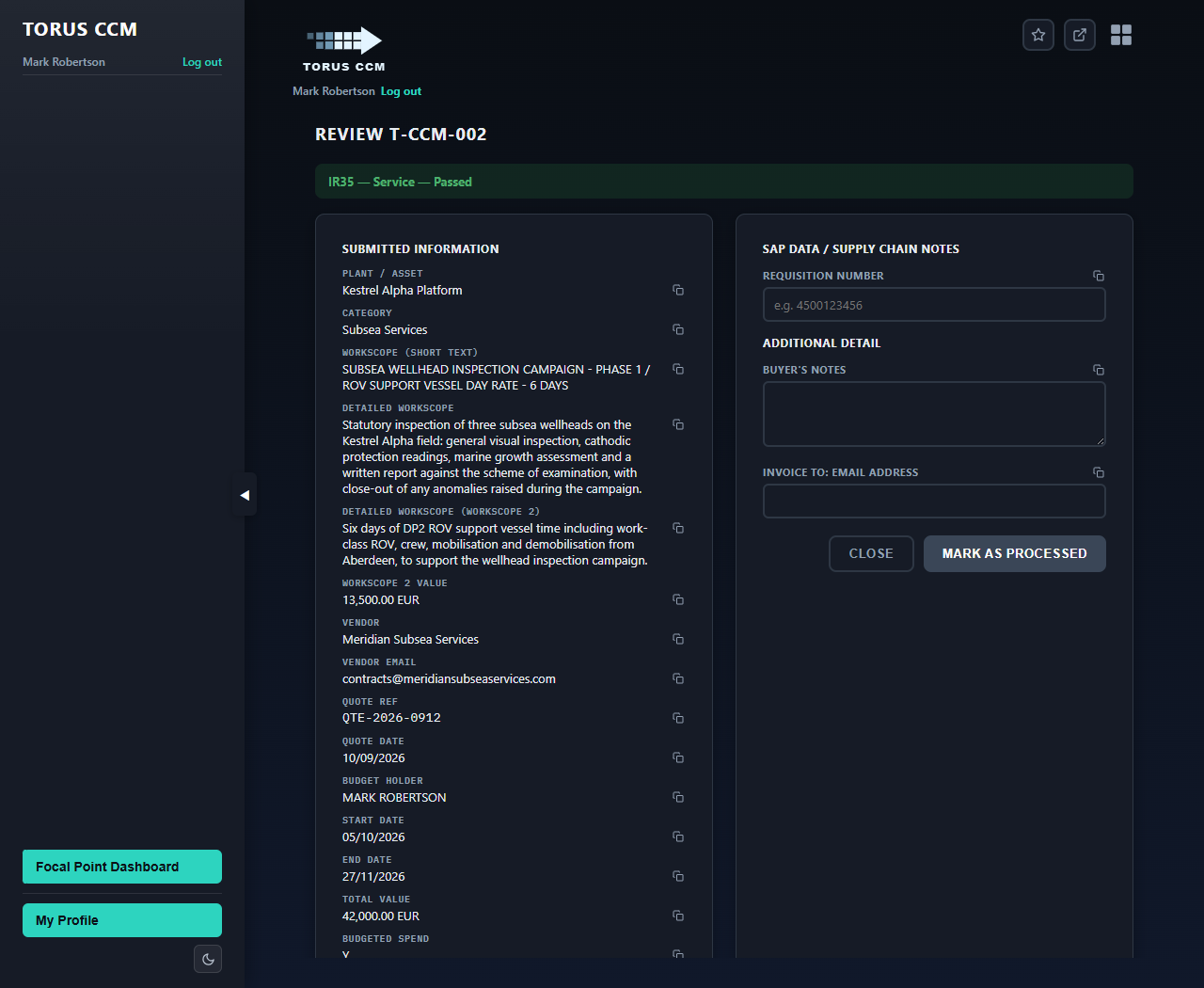
Focal Point Dashboard review screen
4

Approve

An ERP Focal Point reviews the request with full visibility of scope, coding, evidence, and compliance status.

Every acknowledgement, note, and decision is recorded — creating a complete, chronological history.

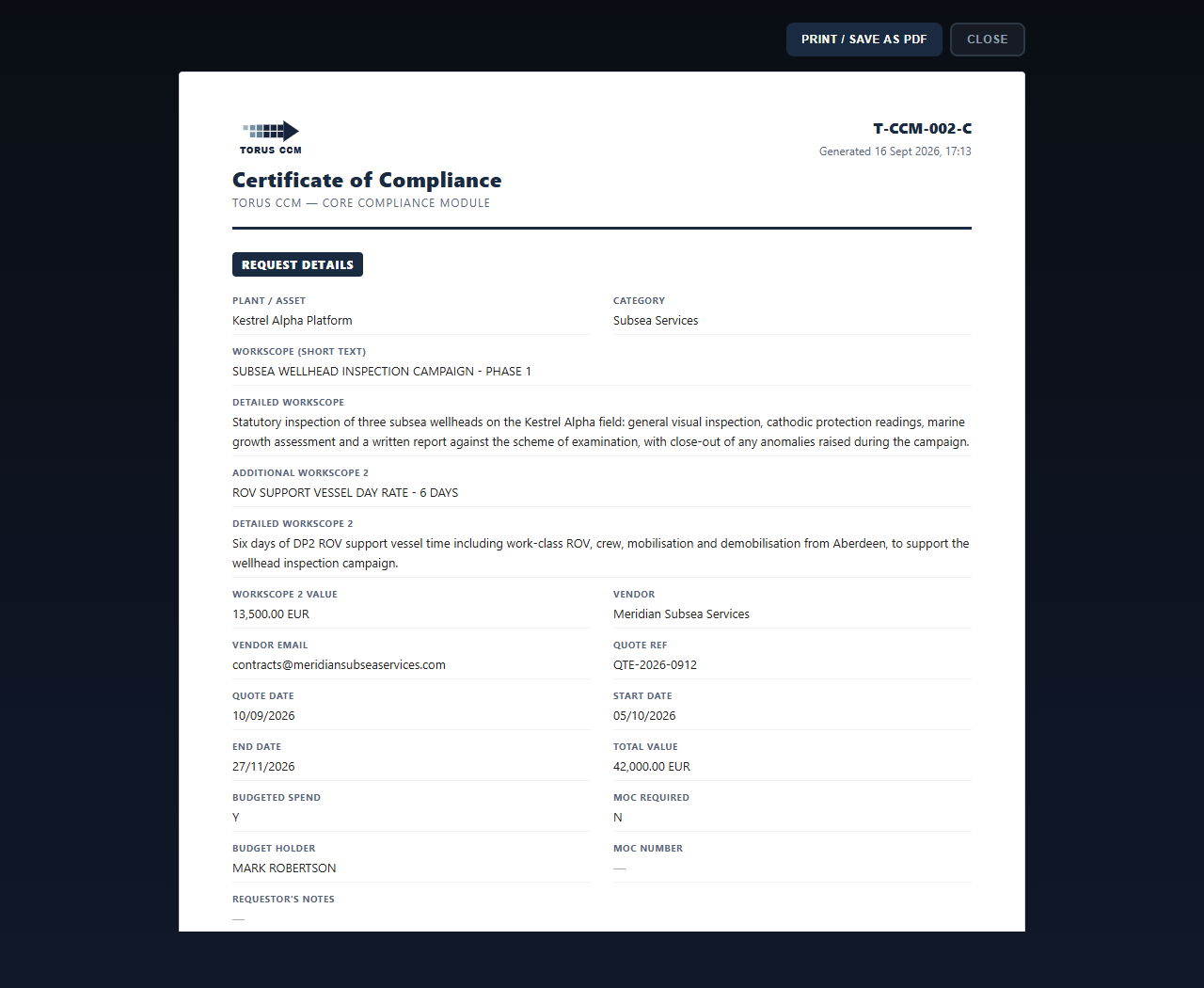
Certificate of Compliance document
5

Certify & Audit

Torus CCM issues the Certificate of Compliance: the full data snapshot, the IR35 answers, the per-line coding, the documents, the activity timeline, the rules it was judged under — and a verification code.

This is the final gate before ERP entry. Anyone holding the document can check it was issued by your instance and hasn't changed since.

THE CERTIFICATE

Proof, not just process

Everything else on this page argues that intake gets cleaner. The Certificate of Compliance is the part that can be proved — by anyone, without an account, long after the request has left the system.

Verification code — printed on every certificate
82B8-F66D-6597-9E23-30CE
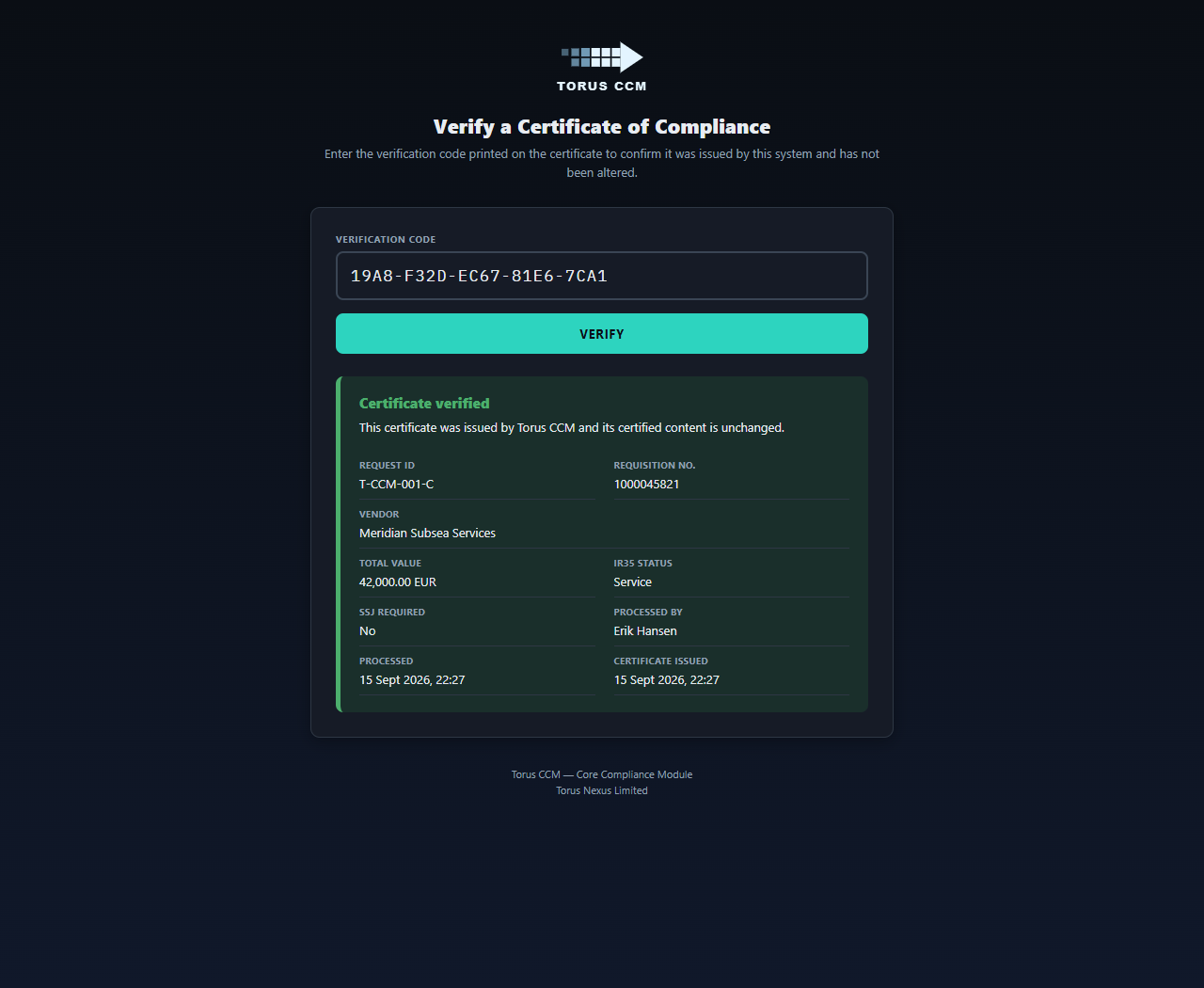
Certificate verifiedThis certificate was issued by Torus CCM and its certified content is unchanged.
VALIDYour instance issued it, and the record still matches the document exactly.
ALTEREDYour instance issued it, but the record no longer matches. Something changed after issue.
SUPERSEDEDGenuine, but a newer version of the record exists — a legitimate later correction, and the current code is returned.
UNKNOWNYour instance never issued it. That is the answer a forged document produces.
  • Re-derived, never looked upVerification doesn't read a stored "verified" flag. It recomputes the signature from the record as it stands right now and compares. Someone who could edit the underlying data still cannot make a tampered record verify.
  • Public, and no account neededAn auditor or a buyer holding a printed certificate types the code into your instance's verification page — no login, no chrome, one answer.
  • Old certificates keep verifyingThe signing format is versioned. A certificate issued by an earlier build is checked exactly the way it was originally produced.

A certificate doesn't just say "this passed". It records what passing meant on the day.

The Rules Applied block of a Certificate of Compliance: IR35 ruleset and banding, SSJ threshold, FX rate, approved-list fingerprints, coding entity, account assignment and tax codes in force
Activity Timeline — who did what, and when
The Activity Timeline block of the same certificate: submitted by the requestor, financial coding completed by Finance Control, marked as processed by the Focal Point, each with a name and timestamp
  • Change a rule next year — every certificate already issued still reads correctlyEach one carries its own copy of the rulebook: the thresholds, the FX rate used, the IR35 ruleset version, fingerprints of the approved lists, and what each coding category meant when the line was coded. Without that, a redefined category silently rewrites every historical document.
  • Produced in the browserA full read-only record page the reviewer prints or saves as PDF. No server-side PDF machinery, nothing to install on any reviewer's machine.
FEATURES

Everything a compliance reviewer will ask for

Purpose-built for the questions procurement and supply chain teams actually get asked in energy contracting.

Materials PR itemised line-item form

Service or Materials — One Workflow

An itemised Materials PR follows the exact same governance path as a Service PR — same thresholds, same approval gates, same audit trail.

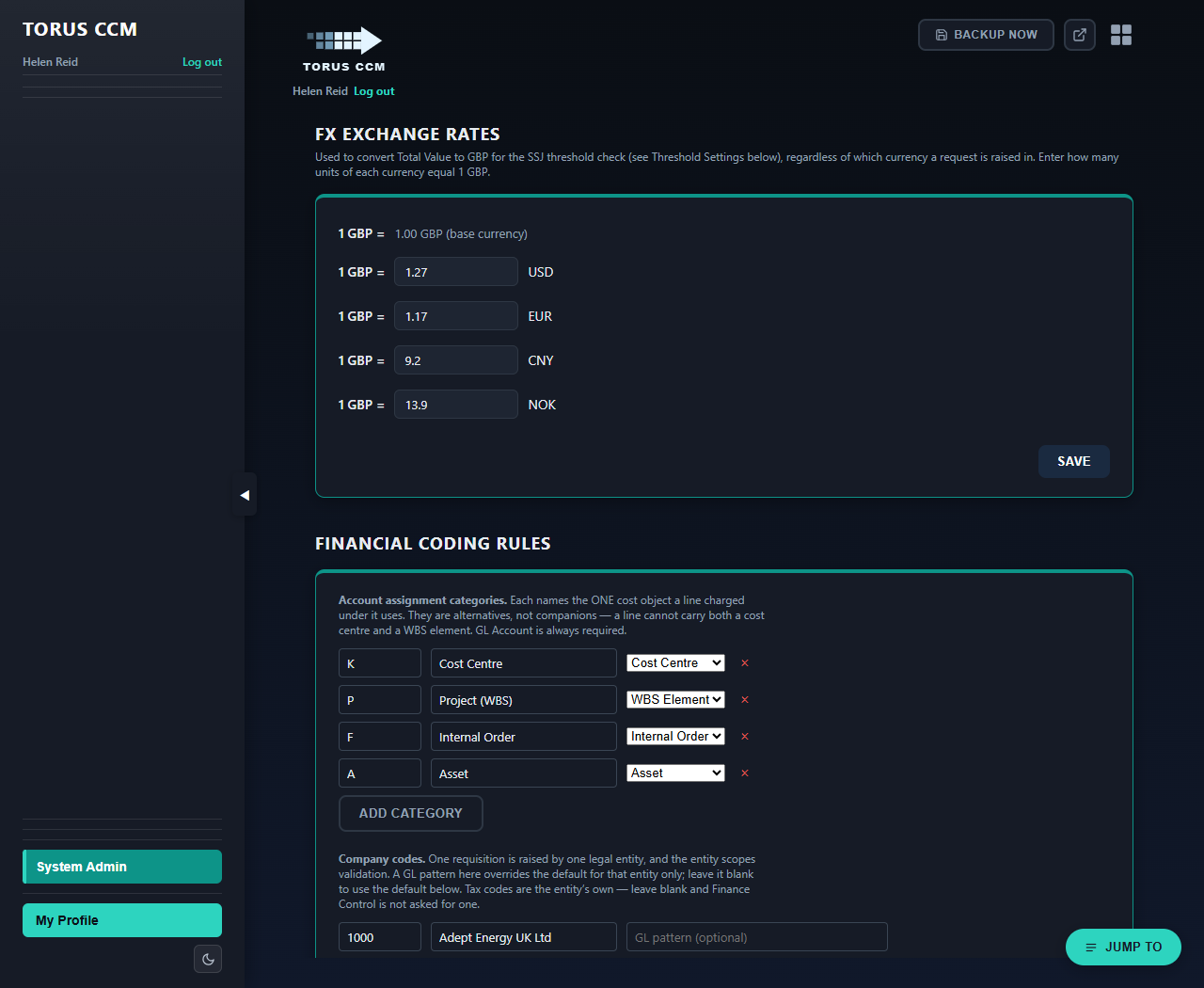
Admin FX rates and threshold settings screen

Configurable, Not Rigid

Every threshold — SSJ value, workscope minimums, exemption justification length — is tunable by your own admin team, not locked to ours.

Search, Filter & CSV Export

Every request list is instantly searchable and filterable by status, vendor, or submitter, with one-click CSV export — GBP-first, currency-aware throughout.

SSJ & Currency-Aware Thresholds

Significant spend requirements convert live against real FX rates, so a threshold means the same thing in any currency.

Approved Vendor, Asset & Category Lists

Requestors pick from a locked, admin-managed list — no free-text vendor names to reconcile later.

Per-Line Financial Coding

SAP account assignment per line — K, P, F or A — each naming the one cost object it uses and ruling out the rest. A requisition split across two cost objects is represented faithfully, not forced onto one code.

Company Codes & Tax Codes

One requisition, one legal entity — and that entity's own format rules and VAT codes. Multi-entity operators code each request under the entity that will carry it.

Joint Venture Billing

Venture, equity group and recovery indicator captured as three fields, so partner-recoverable cost is explicit on the record and never inferred from a single code.

Administration Log

Who changed which rule, and who granted somebody a role. One append-only timeline with no edit or delete route — governance of the governance.

SCREENSHOTS

Looks the part, in either theme

Every screen in Torus CCM ships with a full light and dark mode — not a dark-mode afterthought bolted on later.

Torus CCM Service PR intake form
Finance Control — the coding gate
Finance Control coding review screen
Focal Point — the approval gate
Focal Point Dashboard approval review screen
The Certificate — the output
Certificate of Compliance document
Verification — the public check
Public certificate verification page showing a verified result

Torus CCM isn't a software company guessing at procurement pain points. It's built by people who've reviewed the requests, chased the missing paperwork, corrected coding errors, and explained those corrections to auditors — because they used to be the ones catching the issues by hand.

We've sat in the inboxes.

We've rebuilt the audit trails.

We've fixed the coding after the PO was already processed.

We've dealt with IR35 gaps that should never have made it past intake.

Torus CCM is the tool we needed in those roles — not the tool we thought would sell. It's designed for real operators, real workflows, and real compliance pressure.

SECURITY & DEPLOYMENT

Your own instance, hosted for you — never a shared platform

  • Single-tenant, alwaysA dedicated instance with its own data, its own configuration and its own signing key. Your requisitions are never in a database shared with another operator.
  • Hosted and operated by Torus NexusA dedicated instance on infrastructure we run for you — provisioned, backed up, patched and monitored, with nothing for your IT team to install or maintain.
  • Your own signing keyThe key behind every Certificate of Compliance belongs to your instance alone — visible to your administrators as a fingerprint, never shared with another client, and never used to sign anyone else's certificates.
  • SSO / OIDC loginEnterprise identity provider support alongside standard password authentication.
  • Rate-limited authenticationLogin, registration, and password-reset endpoints are protected against brute-force and abuse.
  • Scheduled backups and one-click restoreAutomatic backups on your chosen interval, with retention, an undoable restore, and an optional second destination away from the primary disk.
  • Three layers of auditA timestamped activity trail on every record, an append-only administration log of rule changes and role grants, and a cryptographic seal on every certificate issued.

Deployment model

Single-tenant pilot

HostingDedicated instance, operated by us
Data isolationDedicated instance
Signing keyHeld by your instance
IdentitySSO (OIDC) or password
OutputCertified requisition record
Production ERP credentialsNone needed
TWO QUESTIONS WE ALWAYS GET

Torus CCM is a system of proof, not a system of execution.

"Why doesn't it just create the PR in SAP?"

Because the bottleneck was never the keying. Torus CCM is ERP-agnostic by design: it hands over a certified, complete, human-checked requisition, and how that enters your ERP is a choice your security team makes at the level it accepts — not one we made for you. We don't need production credentials to be useful, and we'd rather your security team never had to grant them.

01

Minutes to key. Weeks to correct.

Auto-creation doesn't make a bad requisition good — it makes it wrong faster, and now it's wrong inside the ERP, where fixing it means a change document, a reversed approval, possibly a PO amendment.

02

Write access to production is a project, not a feature.

A service account authorised to create financial documents, transports, change control, Basis time, an integration test cycle and a security review. It turns a pilot you can run this quarter into a line in next year's roadmap.

03

The human gate is the product.

The certificate has value because a named person reviewed and accepted the request before the document existed. If the validating system also creates the document, segregation of duties collapses.

"Why doesn't it read the quote for me?"

Because the quote is evidence, not input. Torus CCM attaches it to the record and puts it in front of the people who own the decision, rather than extracting figures from it. Extraction, by OCR or a language model, is probabilistic — a misread decimal in a vendor quote becomes a certified value with your name on it. And sending pricing documents to a third-party parser puts commercial data outside your instance, which is what a dedicated deployment exists to prevent. Values are typed by the requestor and checked by Finance and the Focal Point, with the quote beside them for comparison.

Bring discipline to procurement intake.

Clean Requisitions. Compliant Workflows.

Built by people who've lived the rework, not just studied it. No production ERP credentials needed to get started.

Priced per Certificate of Compliance issued, on a dedicated instance hosted for you. No seat licences.

Email contact@torusnexus.com